
People

The research group

Principal investigator

Lab head
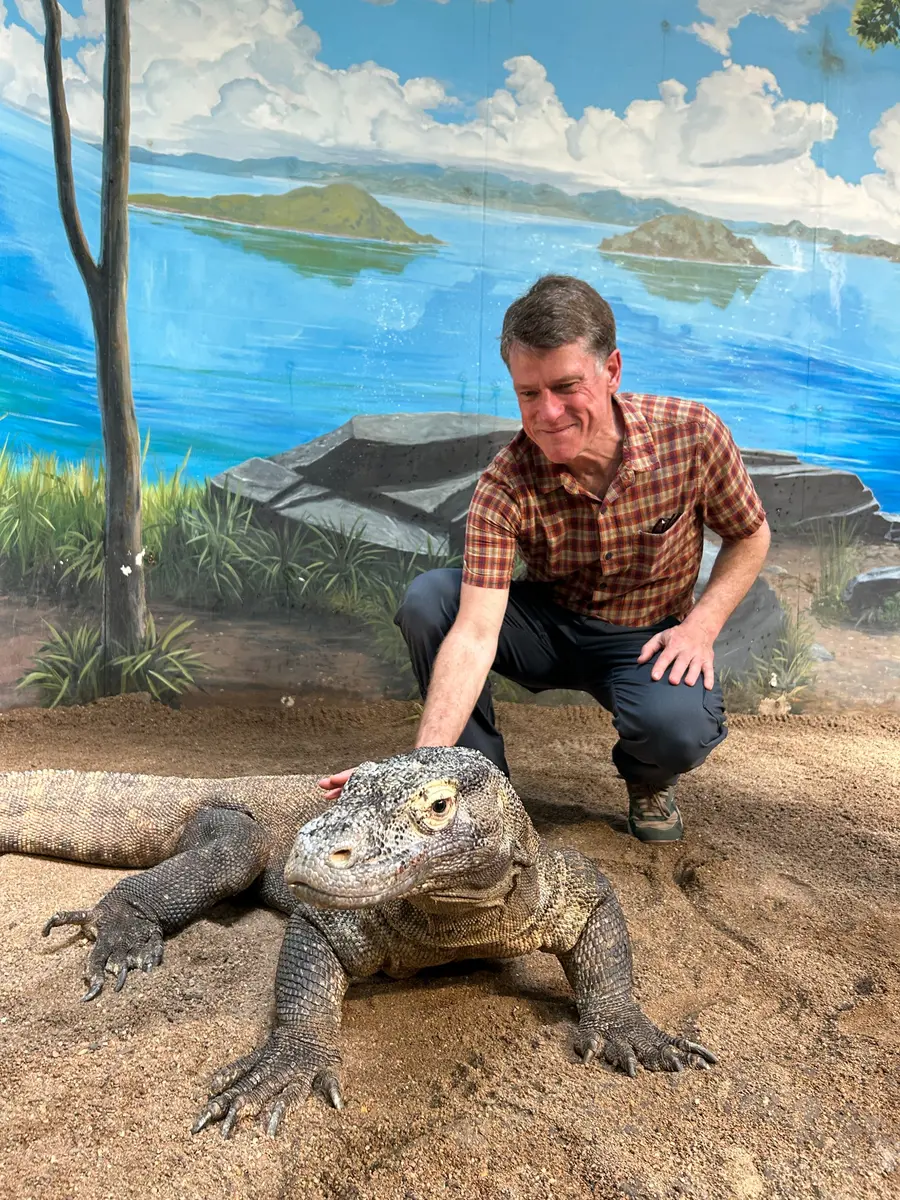
Martin Whiting with a Komodo dragon

Professor of Animal Behaviour

Martin Whiting

Martin Whiting is a Professor of Animal Behaviour in the School of Natural Sciences at Macquarie University. He is a behavioural ecologist who works at both the ultimate and proximate levels of animal behaviour. He currently works on the evolution and maintenance of social behaviour, using mainly lizards as a model system, and is particularly interested in transitions between relatively simple social systems and complex sociality—how these may have evolved—and the mechanisms underpinning them. He also works on cognition and is interested in understanding the role of cognition in fitness, and how the environment and sociality interact in selecting for particular cognitive traits. Finally, his lab has a long history of studying animal communication—particularly colour signals—and their role in both sexual and natural selection. Further details are available on Martin’s linked profile.
Current team

Postdocs

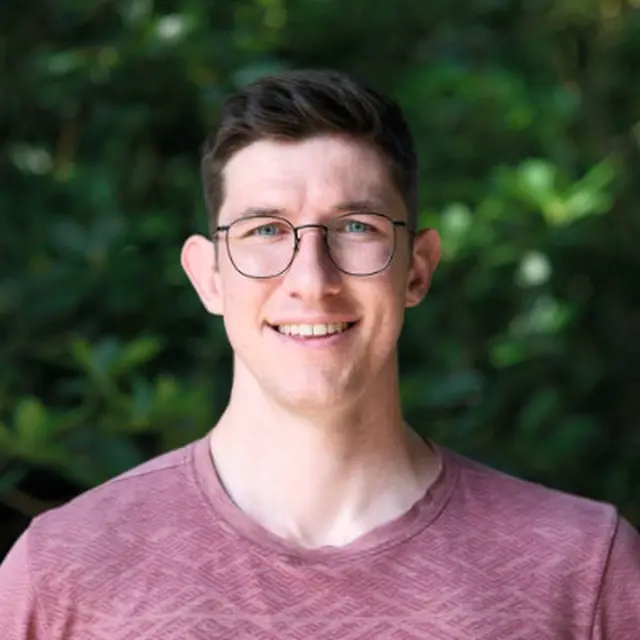
Yorick Lambreghts

Yorick Lambreghts

Yorick’s research focuses on the evolution of sociality in lizards with a particular interest in the role of kin recognition. He is developing a method to make modifications to the genome of Australian lizards using CRISPR-Cas9 in collaboration with Martin and Dr Oliver Griffith. This technique will open the door for a whole suite of new opportunities for research on social evolution and recognition, as well as virtually every other aspect of Australian reptile biology.

During his PhD, Yorick focussed on kin recognition itself, its importance in the early evolution of sociality and how it was refined as social systems became increasingly complex. While he was based at the University of Tasmania in Hobart (BEER group), his field and experimental work took place at Macquarie University in Sydney (Lizard Lab). He is currently working on publishing these findings.

Further information about Yorick and his research is available on his web page and Google Scholar.

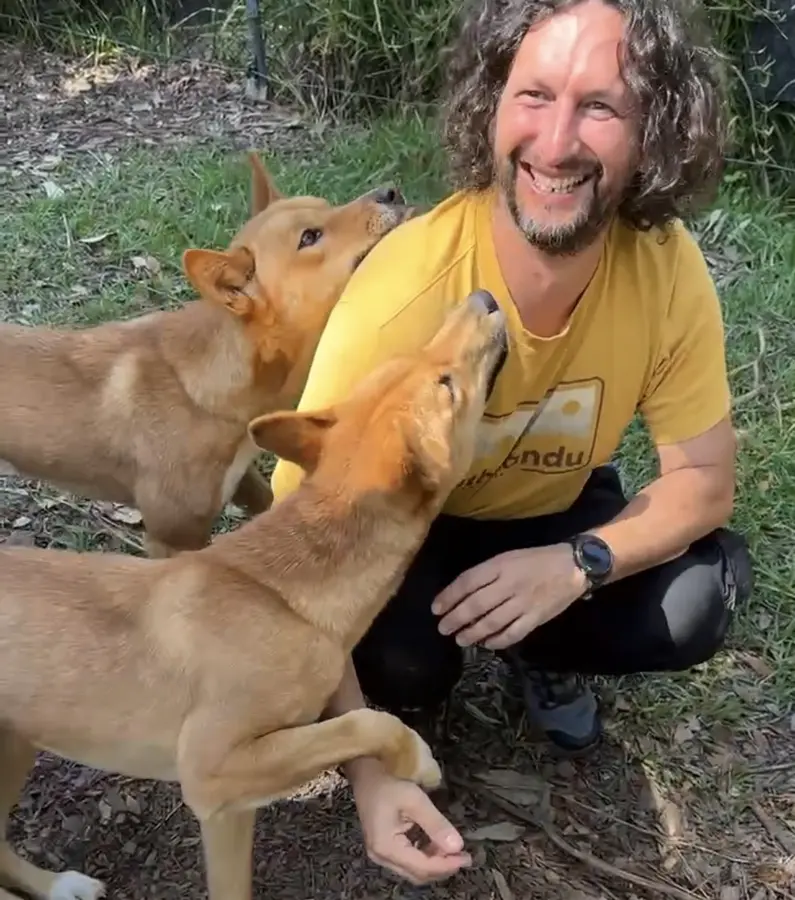
Sergio Naretto with two dingoes

Sergio Naretto

Sergio has a foot in two labs - his other job is echidna wrangler and researcher in Oliver Griffith’s lab. Sergio is on a grant with Martin to research UV-based display behaviour in blue-tongue skinks. Part of this work is synthesising a UV signal in collaboration with nanoparticles engineers at Macquarie. Sergio also has lots of data from his days studying Argentinian lizards at high altitude.

Further information about Sergio’s work is available on his ResearchGate page. Sergio also has a Google Scholar page.

Current team

PhD and MRes students

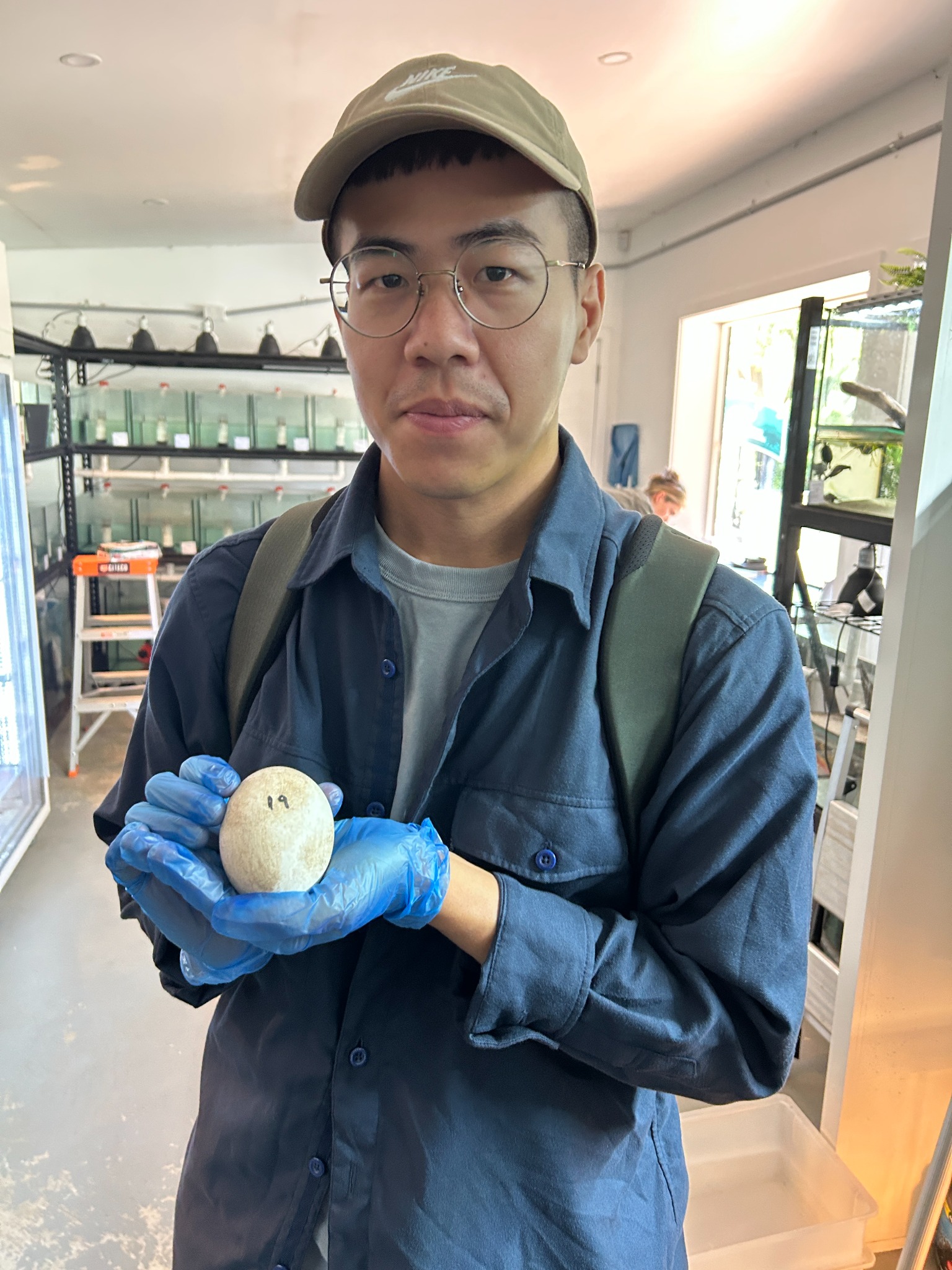
Chien-Chen Huang holding a reptile egg

Chien-Chen Huang

After completing his BA and MSc in Taiwan, Chien-Chen spent five years working at a zoo with people in its wildlife rescue center and animal welfare working group, before leaving everything behind to start his PhD in Australia. His research focuses on the cognitive abilities of goannas (varanids), exploring how cognition relates to ecological traits and spatial ecology, and how it varies across different evolutionary lineages.

Chien has written popular science articles in Chinese: his articles on Facebook →

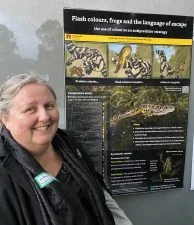
Kathy Potter standing beside her research poster

Kathy Potter

The aim of Kathy's PhD is to uncover the evolution and function of flash signals in frogs and understand their role in potentially deterring predators. This is an extension of Kathy's Masters of research thesis. Kathy is also a gifted musician and long-term member of the Frog and Tadpole Study Group (FATS) of New South Wales.

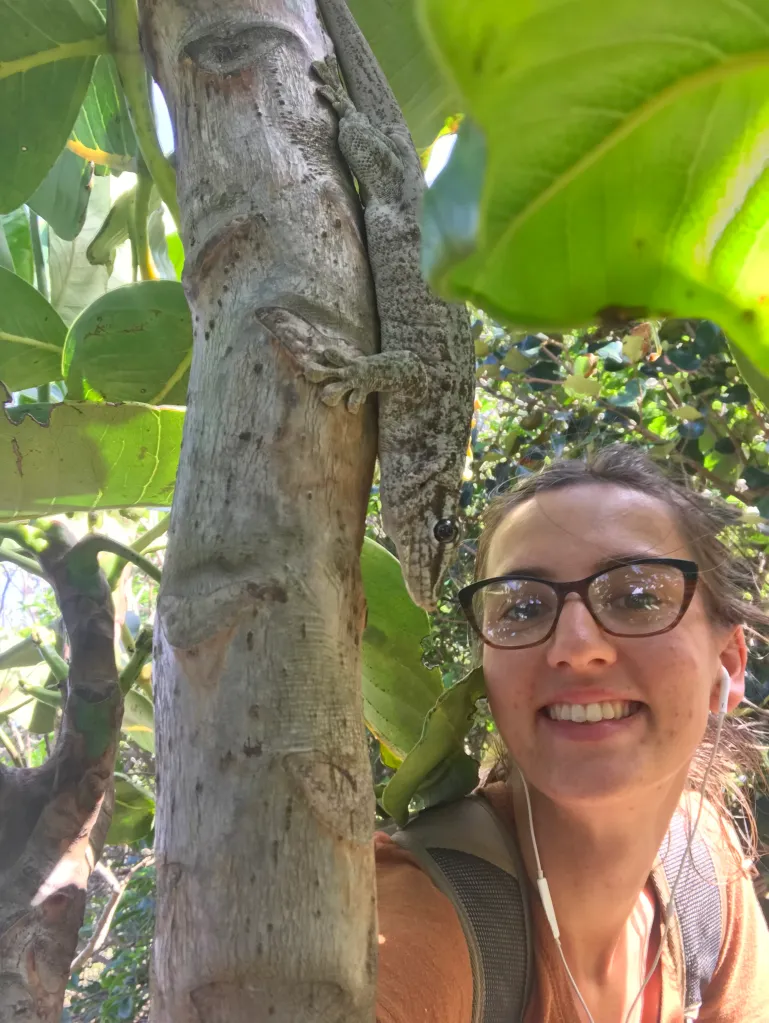
Bethan Govier beside a lizard in a tree

Bethan Govier

Bethan has had a somewhat unconventional journey to starting her PhD but has always known it would centre around lizards! She completed her BSc (Hons) in animal behaviour and welfare in 2015 and went on to work as a reptile keeper at Jersey Zoo in the Channel Islands (UK). She then completed her Master’s in wildlife conservation with her thesis focused on behavioural variation in sand lizards that were destined for reintroduction across southern England. Following this, she spent a few feral years working as a warden on Round Island, an uninhabited nature reserve off the north coast of Mauritius before COVID brought her back to England, where she worked as an ice cream maker and a learning assistant in a children’s nursery… equally as wild!

She is now thrilled at the chance to utilise the skills she has learnt along the way to complete her PhD under the supervision of Martin Whiting and Geoff While. Her PhD began by focusing on how the early social environment influences subsequent social behaviour, personality and cognition. Later, it became more about the behavioural consequences of sex reversal in bearded dragons (Pogona vitticeps).

Collaborators

Visiting researchers

Helena Valverde Iglesias sitting on a rock

Helena Valverde Iglesias 2023–

Helena is a PhD student in the Behavioural and Evolutionary Ecology Research Group at the University of Tasmania, supervised by Geoff While, Ben Halliwell and Erik Wapstra. Helena also collaborates with Martin and has been a regular visitor to the lab. Her research focuses on the mechanisms underlying parental care in Tiliquin skinks, and its evolution. She holds a Bachelor’s degree in Biology from Spain, as well as two Master’s degrees—one in Neuroscience and Behavioural Biology, and another in Biomedical Research. Helena is also an amazing guitar player!

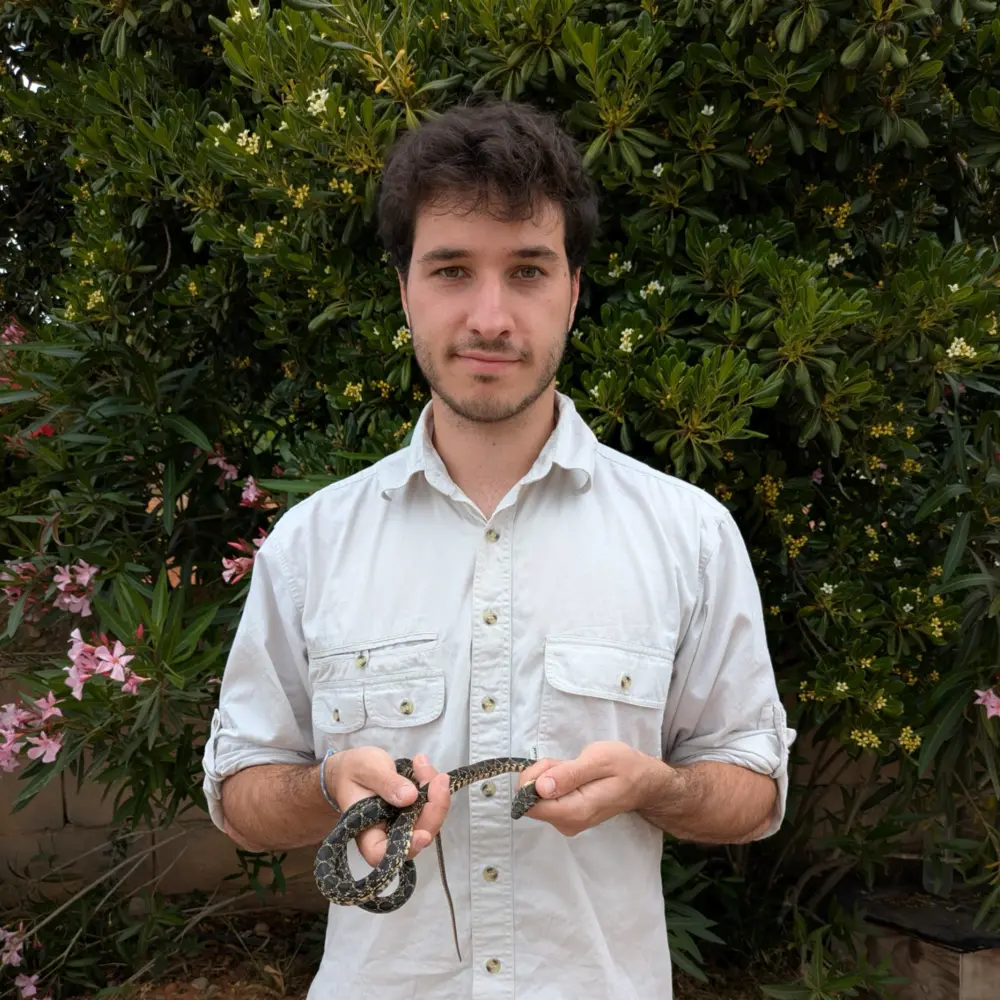
Marc Vez Garzón holding a snake

Marc Vez Garzón

Marc is currently visiting Martin and Rick Shine as a sort of sabbatical to write up his thesis and papers, discuss his work, and generate new ideas. His main interests are focused on animal behaviour, movement ecology, and biological invasions, although he has also collaborated on projects ranging from high mountain plant communities to urban trophic ecology.

At CREAF in Barcelona, he works as a predoctoral researcher in Dr Oriol Lapiedra’s group, studying the ecological and evolutionary dynamics of an invasive snake in the insular system of Ibiza (Balearic Islands). His research focuses on how behavioural variation and spatial sorting shape range expansion, and how these processes scale up to affect native prey populations, species interactions, and ecosystem functioning.

Further information about Marc and his research is available on the CREAF web page, ResearchGate and Google Scholar.

Eamonn Wooster

Eamonn Wooster

Eamonn is an ARC DECRA Fellow at the Gulbali Institute at Charles Sturt University. Eamonn lives in the Blue Mountains and has a desk in the lab. He has collaborated with various members of the lab at different times (see Publications) and is particularly interested in predator–prey interactions and the ecology of individuals. Eamonn asks why individual animals vary so greatly in how they behave. He is also interested in how individual behavioural variation scales up to shape population- and ecosystem-level processes.

Eamonn also looks to uncover how animals and their ecological interactions adapt to human disturbance, and works across a variety of novel anthropogenic stressors, including hunting, climatic change and changing fire regimes.

Further information about Eamonn and his research is available on his web page and Google Scholar.

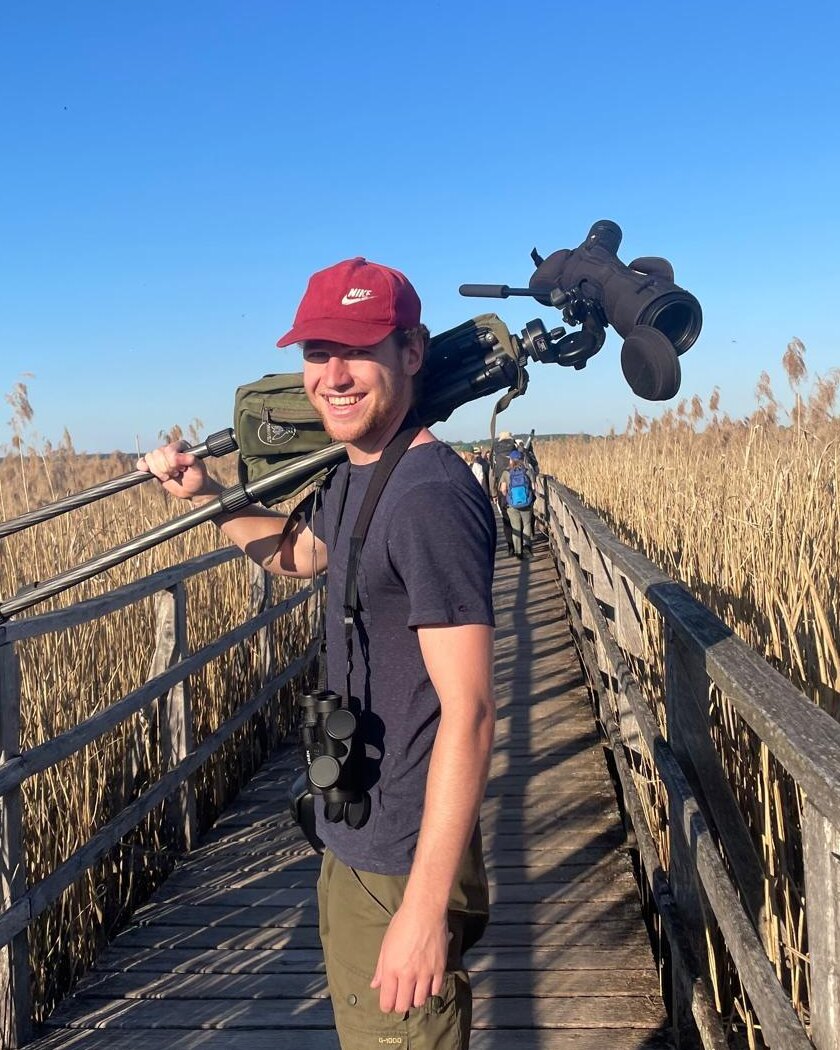
Simon Jeni carrying wildlife photography equipment in the field

Simon Jeni

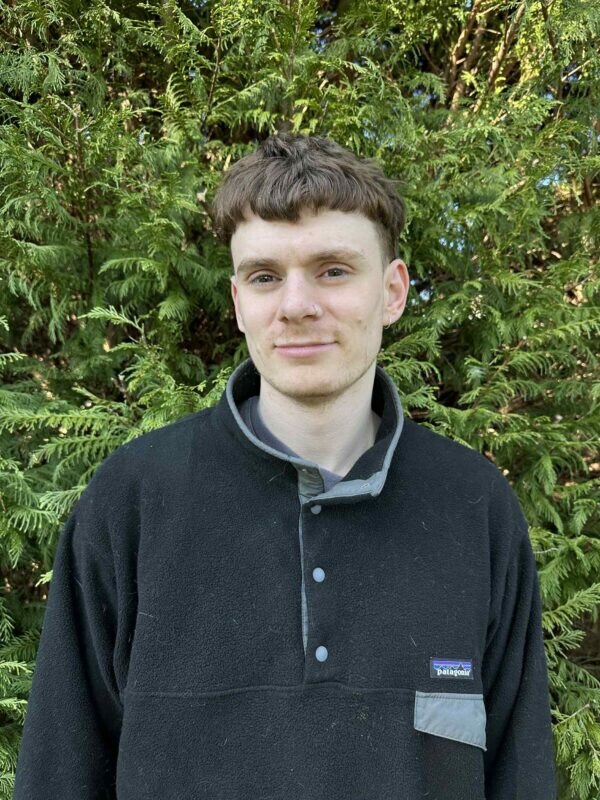
Simon completed his bachelor’s degree in Animal Management at Van Hall Larenstein in Leeuwarden, the Netherlands, where he majored in wildlife management, with his minor focusing on responsible animal use in field research. During that time, he spent one semester in the Bavarian Forest National Park conducting research on the decomposition process of wild boar carcasses.

For his master’s degree, he went to Eberhard Karls University Tübingen, where he is studying Biodiversity, Ecology and Evolution in the Institute for Evolution and Ecology, Department of Biology. During his current visit to the Lizard Lab (2026), he has been studying the decoy effect and quantity discrimination in lizards.

Lab alumni

Hall of fame

Former postdoctoral researchers, students, interns and volunteers form a global network of Lizard Lab alumni.

Visit the Hall of Fame →

Postdocs

Ben AshtonYears to come

Daniel HoopsYears to come

Chris JollyYears to come

Simon Clulow2018–2020

Simon Baeckens2019–2020

Julia Riley2017

Naïla Even2016–2017

Daniel Noble2013–2015

Pau Carazo2011

Phil Byrne2006–2007 · Wits

Lydia Du Toit2005 · Wits

Jessica Stapley2004–2005 · Wits

Devi Stuart-Fox2003–2006 · Wits

Adnan Moussalli2003–2005 · Wits

Students

Kathy PotterMRes 2023

Liam AgnewMRes 2022

Levi BrownMRes 2023

Ko-Huan LeePhD 2022

Victoria RussellYears to come

Kari SoennichsenMRes 2021

Stephanie DeeringMRes 2021

James MaddenMRes 2021

Angela SimmsMRes 2019

Birgit SzaboPhD 2019

Isabel Damas MoreiraPhD 2019

James Baxter-GilbertPhD 2018

Jodie GruberPhD 2018

Arnaud BadianePhD 2018

Julia RileyPhD 2017

Fonti KarMRes 2015

Daniel HoopsPhD 2015

Siobhan DennisonPhD 2015

Marco BarqueroPhD 2014

Dan NoblePhD 2014

Grant WebsterHonours 2012 · Masters 2016

Ben ClarkHonours 2012

Renata KopenaVisiting PhD 2012

Mitch ScottHonours 2011–2012

Kerrie WechmannHonours 2011

Martin van der MeerHonours 2007

Melanie Ferreira-MartinsHonours 2007

Helen PlaceHonours 2006 · PhD 2012

Trevor McIntyreMSc 2006

Toby HibbittsPhD 2006

Luke SchutzHonours 2005

Walter ReisingerHonours 2004

Jörg MelzheimerDiploma 2003

Kinesh ChettyHonours 2003

Belinda LewisHonours 2003 · MSc 2007

Tasmin RymerHonours 2002

Kathy HernstadHonours 2001

Sue McConnachieHonours 2000 · PhD 2006

Simon LailvauxMSc 2002

Leann ReaneyMSc 2002

Rhett SmartMSc 2001

Monica WymanDiploma 2001

Lanral RuddockMSc 2000

Pius KornerDiploma 1999

Undergrads, volunteers and interns

2010–2012

Viviana · Yian Yian Dam · Sebastian Schwarz · Marc Nardini · Ferdy Timmerman · Danny Boerrigter · Grant Napier · David Hamilton · Laura Hagemann · Moniek Poppe · Nicolas Butruille · Nicolas Villain · Martin Rossmanith · Suead Zamut · Yee Wah Lau · Sam Tesoriero · Stephanie Muenchau · Nathalie Lallemand De Driesen · Kathi Hinz · Aljoscha Kubassa

2013–2017

Stephanie Wilson · Tim Maher · Shanna Rose · Yvonne Skrzypczak · Floriane Passas · Maribel DeGuzman · Peta Vine · Elijah Elias · Lorene Chieze · Marie Favre · James Baxter-Gilbert · Côme Guidou · Caroline Fryns · Anna Küchler · Théo Damasio · Mitchell Francis · Jo Ocock · Sam Perkins · Dena Paris · Sarah Deventer · Josh Cunningham · Sam Ramsay · Beatrice Baraldi · Roxy Sultana · Matthieu Monserand · Max Mühlenhaupt · Maiana Lenoir

2018–2023

Cooper Van Der Wal · Sebastian Hoefer · Victorien Durand · Rebecca Loiseleur · Levin Wiedenroth · Victor Frichot · Jane Mademann · Faustine Degottex · Jordan Steele · Jonathan Ogle · Marco Monteiro · Kaitlin McCloghry · Constant Perry · Harry Fryer · Sam Brennan · Sami Richardson · Levi Brown · Sophie Hall · Jarrad Prangell · Phil Topham · Sébastien Chiasson D’Herbomez · Yieh Shing Tan · James Blackie · Clément Gourjade-Goselin · Kylian Miklos · Marlene Völker · Shane Lombardo · Millie Clark · Nik Desmet · Erik Ferraro · Liz Peni-Pearson · Will Bailes

Husbandry team

Peta Vine · Courtney Walcott · Heather Fisher · Michelle Lucietto · Kailyn Mclennan · Jarrad Barnes · Clare Ottaviano · Michelle Chan · Greg Everden · Li Levi · Laura Auckett · Jared Martin · Taylor Wilkinson · Jack Westacott · Teagan Parker Kielniacz · Luke Jeffery · Jordan Theobold · Joshua Cunningham · Ann Ching · Megan Johnson · Pandelitsa Yiasemides · Marco Monteiro · Daniel Ali · Tian Xing Yang

Getting involved

Undergrads, interns, volunteers

Undergraduate researchers, interns and volunteers make an important contribution to lab and field projects while gaining hands-on research experience. Prospective volunteers can contact the lab about opportunities—availability depends on what projects are active at the time.

Collaboration

Global collaborative network

The interactive map shows the researchers and institutions connected through co-authored publications across 47 countries.

Explore the interactive map →